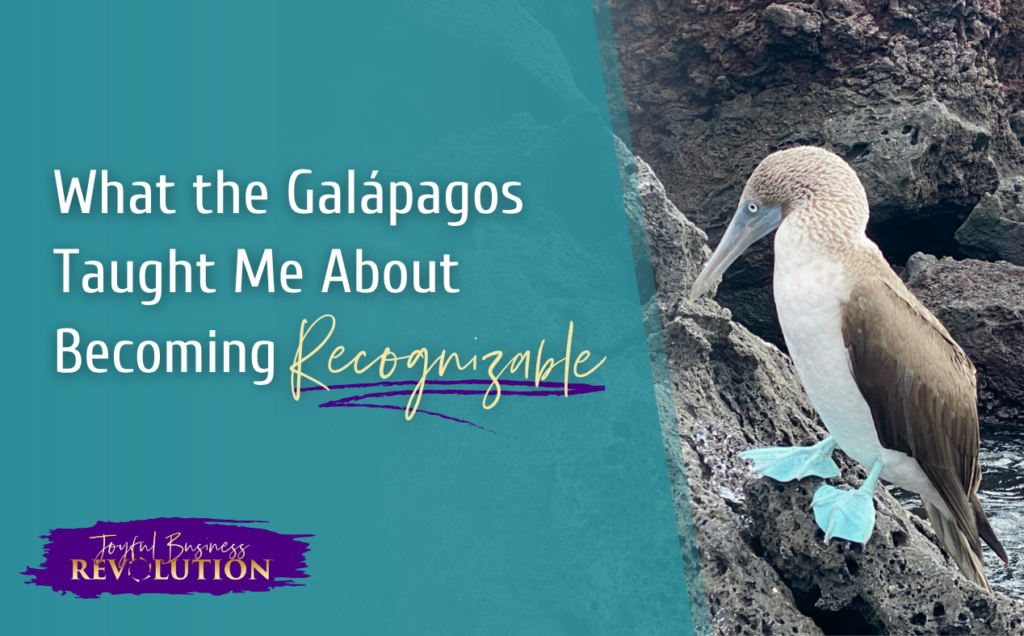
The Field Notes I Didn’t Know I Was Taking
There are seasons in an established business when nothing is obviously wrong, but the language you have been using starts to feel strangely insufficient. The work is still good. People know you and your clients get results. You probably have more credibility and visibility than you did a few years ago; yet, explaining what you actually do has somehow become more difficult.
Part of what makes this hard to diagnose is that the old message may still be true: It describes work you have done, expertise you genuinely have, and perhaps even the thing people first came to know you for. It is simply no longer the whole story, which means you find yourself filling in the rest when someone asks a deeper question, when a referral arrives with an outdated understanding of your work, or when a sales conversation moves beyond what the website has managed to communicate.
I have been thinking about that lately while looking through photographs from a trip I took to the Galápagos Islands.
I have a master’s degree in biology, so when I was there I was looking through the lens you would probably expect: adaptation, environment, behavior, form, and all the strange and remarkable ways life had developed in response to a very particular place. I certainly was not walking around thinking about positioning or trying to extract business lessons from a sea lion.
But photographs are interesting that way. You can return to the same image years later with a different body of experience and notice something you were not looking for the first time.
Looking at these photographs now through the lens of my work as a messaging strategist, I keep seeing recognition.
I see traits that make one species immediately distinguishable from another. I see signals that carry meaning because something in the environment knows how to interpret them. I see adaptation that has happened over time rather than all at once. And underneath all of that, I see a question that feels surprisingly relevant to the businesses I work with now:
What makes something recognizable, and what happens when the way we are recognized no longer reflects what we’ve become?
What Makes Something Recognizable?
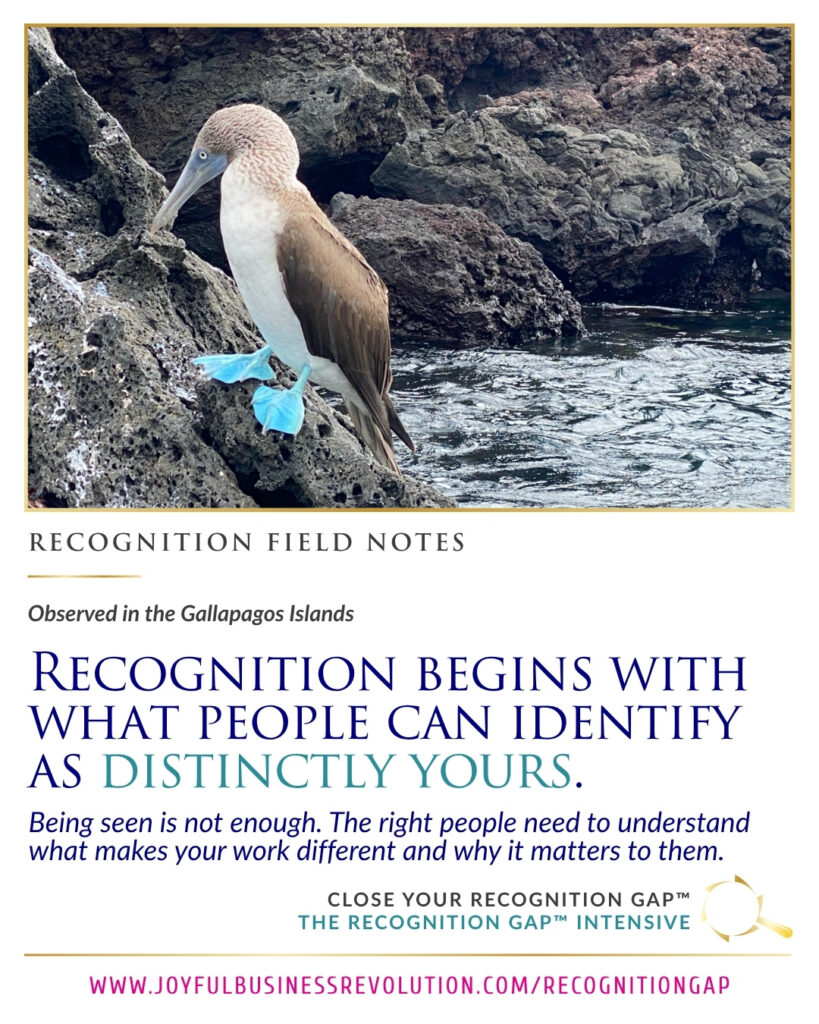
There are details you notice in the Galápagos because you have learned to look for them, and then there are blue feet.
You do not need a field guide open in your hands for long before the association becomes automatic. The feet are not the whole bird, and they certainly do not explain everything interesting about it, but they give recognition somewhere to begin.
That distinction matters in business because experts often approach messaging from the opposite direction. We know the full complexity of the work, so we assume that good messaging should somehow communicate all of it. We want people to understand the methodology, the years of experience, the nuance of our thinking, the different ways we can help, the context behind our decisions, and every subtle distinction that makes the work better than a simpler description can capture.
But the person encountering the business for the first time does not need the entire body of work in order to begin recognizing it. They need enough specificity to understand what belongs to you, what you see differently, and why that difference might matter in the situation they are already trying to solve.
This is where visibility and recognition start to separate.
Visibility tells us that someone had the opportunity to encounter the business. Recognition tells us what became clear because they did.
Those two things are easy to collapse when marketing is not producing the response we expected. We see low movement and assume the answer is more reach, more consistency, more content, or another channel, when the more useful question may be what the existing visibility is actually helping people understand.
An established expert can be widely known and still be incompletely understood. People may enjoy the content, trust the person behind it, refer their name, and recognize that they are intelligent without being able to explain what makes the work particularly relevant, distinct, or valuable now.
That is why more visibility does not necessarily correct an unclear message. It amplifies whatever the message is already making recognizable.
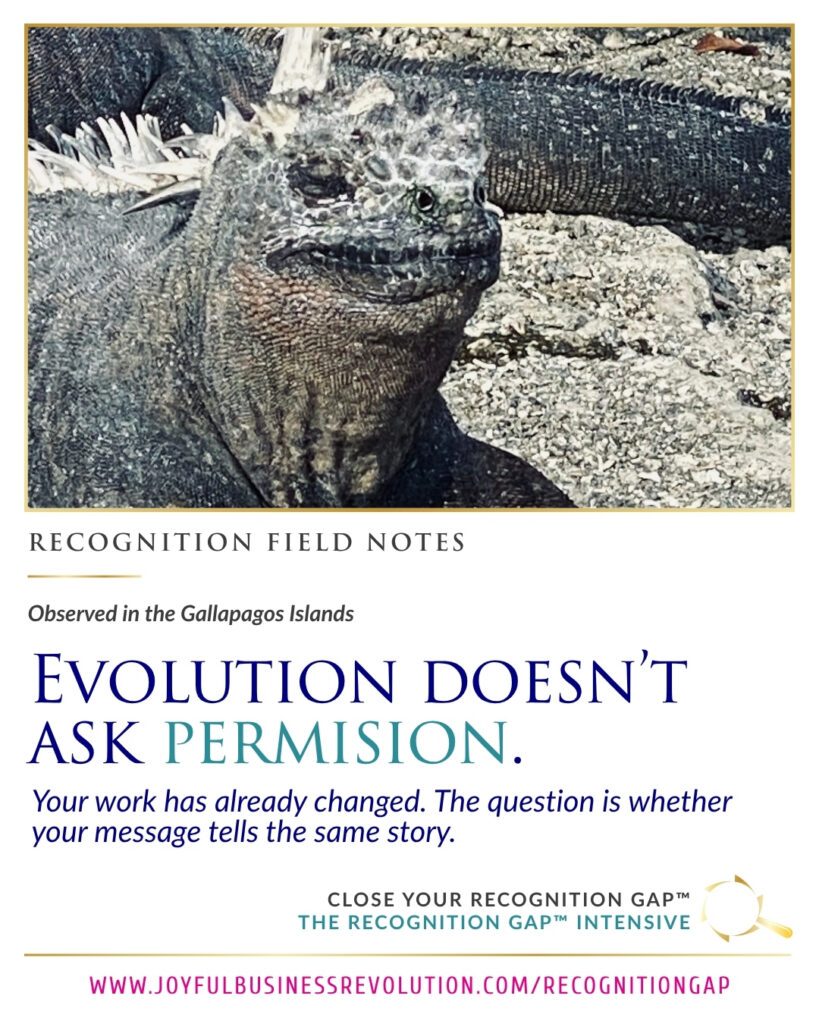
When the Work Evolves Before the Message Does
One of the things I remember most clearly about studying biology is how much of evolution only becomes obvious when you have enough distance to see what changed.
While the adaptation itself is taking place, life is simply responding to the conditions around it.
Businesses change in much the same way. Rarely does an established expert wake up on a Tuesday and decide that the entire depth of their thinking will now be different.
Expertise develops through accumulation. You work with more clients, see the same problem in different forms, discover where your earlier assumptions were incomplete, sharpen your judgment, and begin noticing things you could not have seen five years earlier because you had not yet lived through the work required to see them.
At some point you realize that the problem you solve is not quite the problem you used to describe. Your work may have become more sophisticated, your point of view more specific, your best clients different, or the outcome itself more expansive than the language you have been carrying forward.
That is what I mean by Identity Evolution™.
The person leading the business has changed inside the work, and the work has changed because of it. What does not happen automatically is the translation of that evolution into a message other people can understand.
Your homepage will happily keep describing the version of your expertise you wrote about three years ago. A referral partner may continue introducing you through the language they learned when they first knew you. Your own shorthand can keep pulling you toward a category that is familiar and technically accurate even when you know, somewhere underneath it, that it is becoming too small.
This is one of the reasons established experts can struggle with messaging even after years of being very good at communicating their work. The challenge is no longer finding words for something new. It is recognizing that the words that helped build the reputation may now be preserving an older understanding of it.
The business has evolved, but the market’s picture of it may not have evolved at the same speed.

The Weight a Message Has to Carry
I keep coming back to the tortoise photographs because a shell makes growth visible in a way we do not often get to see.
There is history in the structure. What exists now has developed over time, carrying evidence of what came before it rather than erasing that history each time something changes.
I think reputation works like that.
When you have been in business for a while, you are not building recognition from a blank page. People already associate you with certain ideas, services, results, stories, industries, frameworks, or ways of working. Those associations have value because you earned them over years, and there is no reason to treat the earlier version of the business as a mistake simply because you have evolved beyond it.
The tension appears when that reputation becomes the primary container for work that has grown larger than the container itself.
You can see this most clearly in how much translation the founder has to provide.
Someone lands on the website and understands the category but not the depth, so the real value becomes clear once they speak with you. A referral arrives because a former client knows you are excellent, but they describe you using language that belongs to work you no longer want to lead with. Your content generates interest, but the connection between the insight you share and the work someone can actually hire you for is still largely dependent on you making that connection personally.
At first, this can feel like part of doing business. Of course you explain. Of course conversations create context. Of course there will always be nuances that a website cannot carry.
But there is a point at which the amount of explanation becomes useful data.
If people consistently need you in the room before they understand what makes the work different, why the problem matters now, or what your deeper expertise makes possible, then your message is not yet carrying enough of the work on its own.
That is the place I call The Recognition Gap™.
The Recognition Gap™ is the space between what your work actually does and what your audience immediately understands about it. In an established business, that gap is often created because the expertise has continued evolving while the message, positioning, offers, or reputation have continued communicating an earlier version of what the market should recognize.
The cost of that gap is easy to underestimate because the founder can compensate for it.
You know how to explain the work. You know which examples make the idea click. You can hear the confusion in a prospect’s question and answer the thing underneath it. You know how to connect a referral’s outdated description with what you actually do today.
So the business continues working.
It simply becomes more dependent on you to create understanding manually.
That is why a message that no longer carries the full weight of the work eventually becomes more than a copy problem. It changes how much energy marketing requires, how much translation happens in sales, which opportunities find their way to you, and how easily other people can carry an accurate understanding of your work into rooms where you are not present.
Your reputation is not in question. The question is whether it is accurately carrying the work you are here to lead now.
Recognition Depends on the Signal
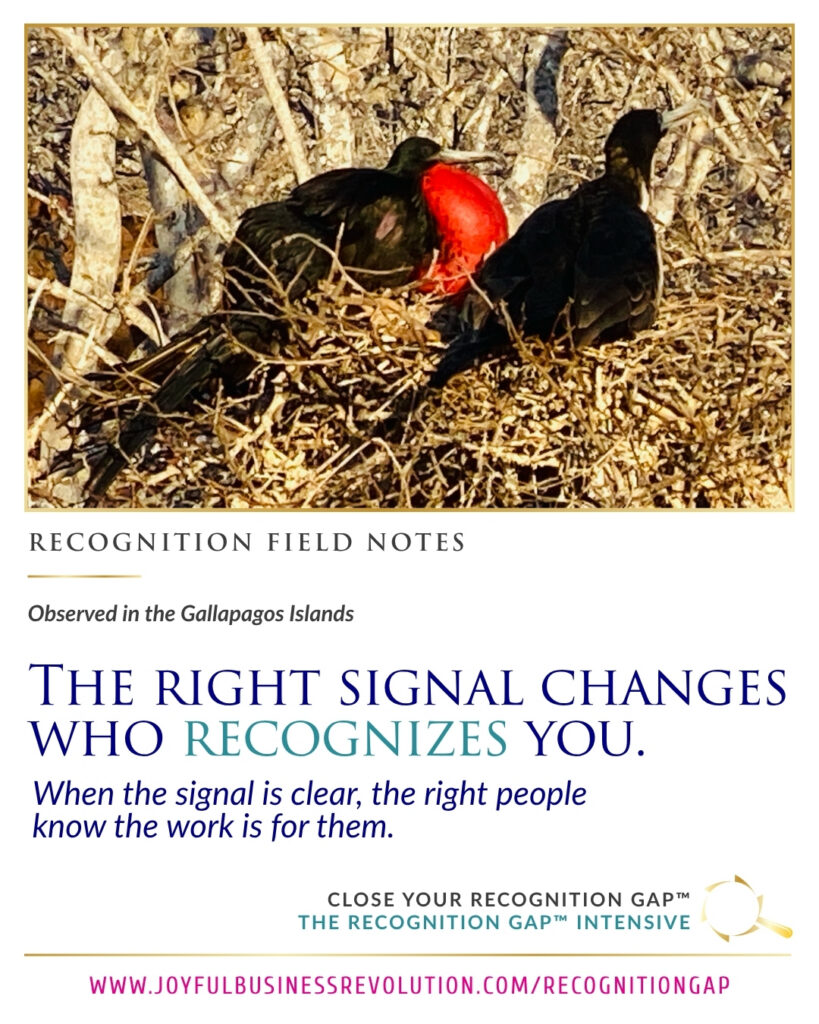
A frigatebird gives you plenty to notice, but once you have seen the distinctive red throat pouch of the male, it becomes difficult to miss.
What interested me when I came back to this photograph was not simply that the signal was visible. It was that the signal carried meaning within a context.
Messaging works the same way.
A strong business message is not an attempt to explain every dimension of the expert behind it. It gives the right person enough information to understand what matters about the work in relation to the situation they are already in.
That is a different standard from completeness.
Experts tend to have an understandable bias toward completeness because we know how much nuance lives underneath the work. We can see all the exceptions, all the caveats, all the ways two client situations that look similar from the outside are actually quite different once you understand what is happening underneath them.
The problem is that when we try to preserve all of that nuance in the first layer of the message, we can make the audience responsible for figuring out which parts matter to them.
Recognition asks for more discernment from the expert.
What does the right person need to recognize first?
Perhaps it is the accuracy of the diagnosis. Perhaps it is a distinction you make that changes the way they understand a problem they have been struggling to solve. Perhaps it is a phrase that finally gives language to something they have been experiencing but have not been able to articulate.
The message does not need to tell them everything in that moment. It needs to create enough understanding that the next piece of information has somewhere to land.
This is one of the reasons specificity matters so much in expert-led businesses.
Specificity is not about narrowing the language until it excludes the complexity of the work. It is about deciding which signals will help the right people recognize that there is something here they should understand more deeply.

What Changes When People Understand the Work More Quickly
I have a photograph of a sea lion that, every time I look at it, seems completely unconcerned with whether anyone is paying attention.
I am aware that the sea lion did not develop a content strategy. 😂
But the image has stayed with me because there is something about the absence of performance that connects to a tension I see in established businesses all the time.
When a message requires too much interpretation, the natural response is often to add more marketing around it. More content gives us more opportunities to explain. More nurture gives us more time to build understanding. More launch activity gives us more chances to say the thing a slightly different way. More visibility creates more opportunities for someone to eventually connect all the pieces.
There is nothing inherently wrong with any of those activities. The issue is what they are compensating for.
If your audience needs repeated exposure because trust takes time, that is one thing. If they need repeated exposure because no single encounter gives them a clear enough understanding of what the work does, who it matters for, or why your perspective is meaningfully different, then increasing the volume of marketing may leave the underlying problem untouched.
This is where Demand Without Force™ becomes useful as a strategic lens.
Demand without force does not mean that a business stops marketing or that the right clients somehow appear without effort. It means we reduce the amount of manual persuasion, translation, and manufactured momentum required because the message itself creates more recognition before the founder has to step in.
When that happens, a sales conversation can start further down the road. A referral can arrive with a more accurate understanding of why they were sent to you. Content can do more than demonstrate intelligence; it can help someone understand how your way of seeing the problem changes what they may need to do next.
The business is still being led and the work is still being marketed. But less of the demand depends on the founder personally carrying people from attention all the way to understanding.
Recognizable Does Not Mean Manufactured
There is another problem that shows up when established experts decide they want a more distinctive message: they start looking for ways to appear different.
I understand why. We have spent years in a business culture that talks about standing out, differentiating, finding a niche, developing a signature process, and creating language that nobody else is using.
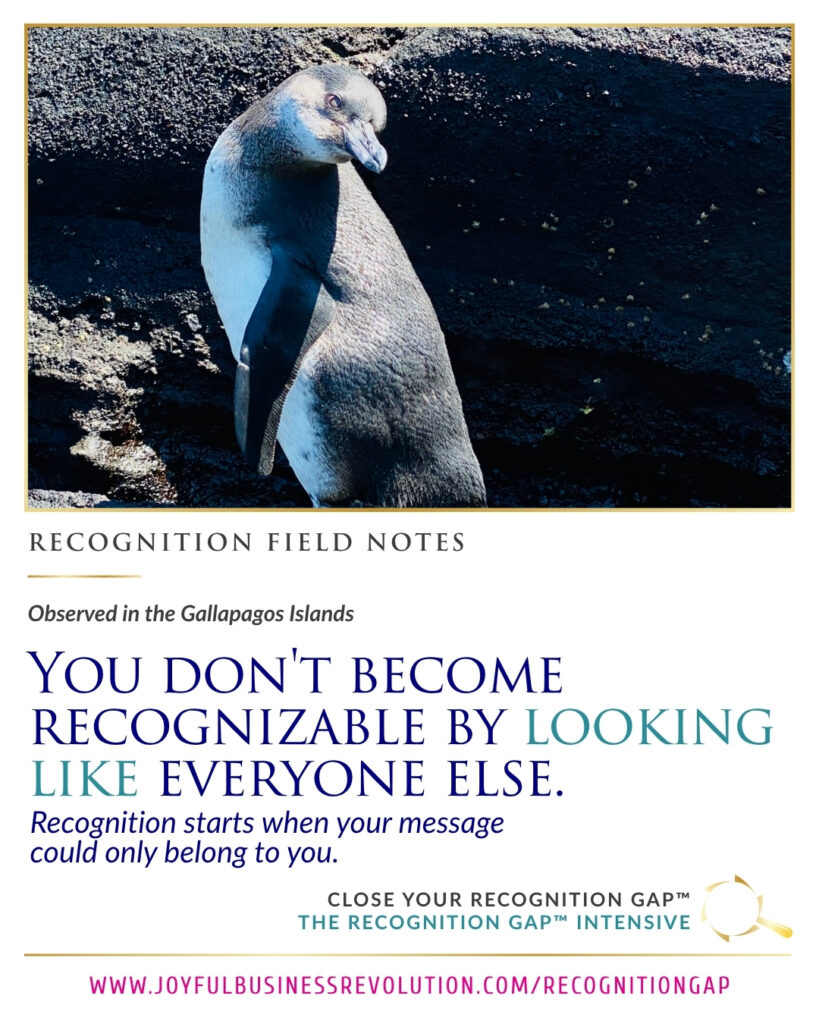
But manufactured difference is not the same thing as recognition.
In fact, I think the pressure to sound distinctive is partly responsible for how much expert messaging has started to sound the same.
People with very different histories, bodies of work, intellectual influences, client experiences, and ways of seeing the world end up reaching for the same language because the language itself has become a kind of shorthand for expertise. Strategic. Transformational. Holistic. Bespoke. High-level. Results-driven.
None of those words is necessarily wrong. They simply ask the audience to do almost all of the interpretive work.
When I talk about Recognizable Brands™, I am interested in something much more grounded.
It is in what you notice before other people notice it. It is in the questions you ask because years of experience taught you where the real problem tends to hide. It is in what you no longer recommend even though it is still standard advice in your industry. It is in the way your work connects ideas that other people tend to keep separate.
Your message becomes more recognizable when those patterns become easier for someone else to see.
That does not require inventing a personality for the brand or packaging every idea into a catchy framework. Often it requires the opposite: enough clarity about what is actually yours that you can stop borrowing the language everyone else is using to sound credible.
The goal is not to look different for the sake of being noticed. It is to make the difference that already exists in the work easier to recognize.
Every Great Discovery Begins With a Different Way of Seeing
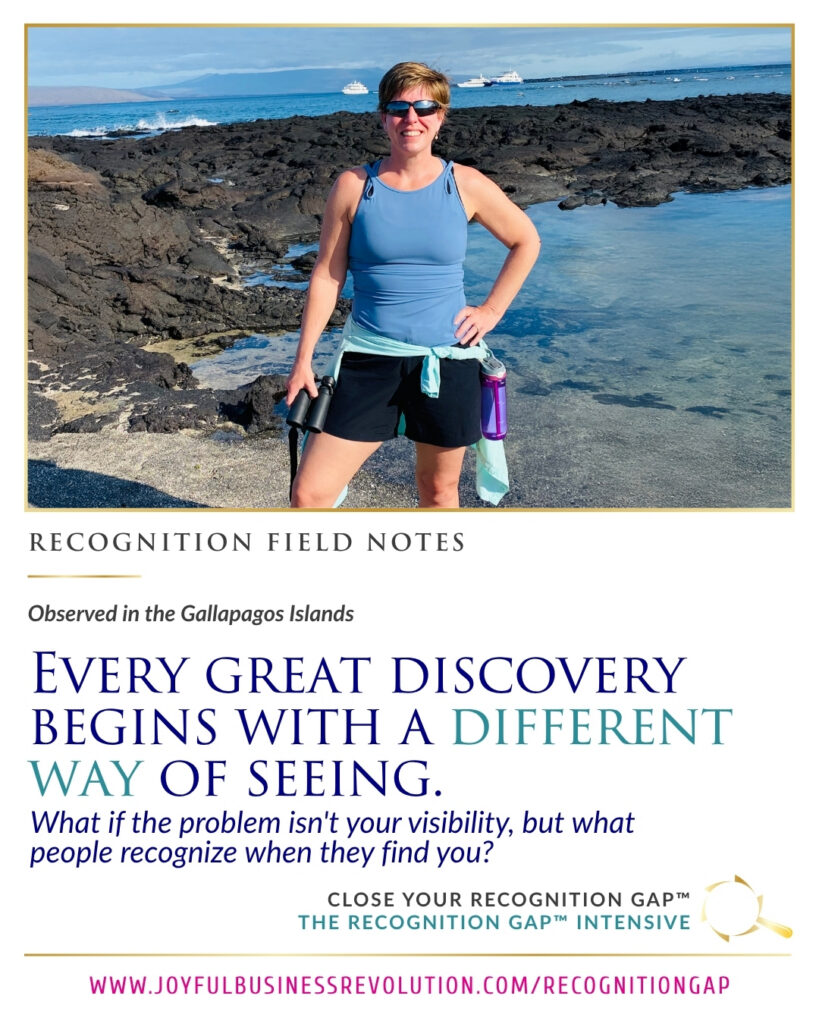
he final photograph in this series is me with a pair of binoculars, which feels appropriate because the thing I have carried most consistently from science into business is not random facts I learned in graduate school.
It is a way of looking and observing that comes before diagnosis.
It’s when you spend enough time with what is actually happening that you have a chance of distinguishing the pattern from the explanation you assumed you would find.
That sounds obvious until we look at how quickly we diagnose our own marketing.
When content is not creating enough movement, we decide we need more reach. When sales feel slower, we decide the audience needs more nurturing. When people do not respond to an offer the way we expected, we change the offer. When the business feels quieter than we would like, we look for another platform, another campaign, another strategy that might put us in front of more people.
Sometimes those are exactly the right decisions.
But before making them, I think there is another set of questions worth asking.
- When someone encounters your business today, what version of your work are they actually meeting?
- Does the message reflect the way you think and work now, or is it still carrying language from the season when your reputation was first taking shape?
- Can people recognize what makes your perspective distinctive without needing the longer explanation that usually happens once you are personally involved?
- Do your referral partners know how to describe the work you want to be known for now, or are they continuing to send people toward an older version of the business?
- When someone appreciates your content but does not move toward your offer, is the missing piece really attention, or have they not yet understood enough of the relevance to recognize why the work matters to them?
And perhaps the most revealing question of all: how much of the depth of your work is your message carrying before you enter the room, and how much are you still carrying yourself?
Those questions lead to a different kind of diagnosis because they start with what people are actually recognizing rather than what we assume they need more of.
That is what I see now when I look back through these photographs.
I went to the Galápagos thinking about evolution because that was the lens I had with me at the time. Years later, after spending so much of my work helping established experts translate what their businesses have become, I can see another part of the same story.
Things evolve, however, the way they are recognized does not always evolve at the same pace.
And if your business has reached a point where the work is deeper than the language surrounding it, more visibility may not be the first problem worth solving.
What if the problem isn’t your visibility, but what people recognize when they find you?
Frequently Asked Questions
What does it mean when your business has evolved but your messaging hasn’t?
It means the way you describe and position the business no longer fully reflects the expertise, perspective, problems, clients, or body of work you have grown into. The old message may still be accurate in part, but it requires you to provide additional context before people understand the work at the level you now deliver it.
How do I know whether I have a visibility problem or a messaging problem?
Look at what happens after people encounter the business. If the right people rarely find you at all, visibility may need attention. If people are already finding you, consuming your content, hearing about you through referrals, or entering conversations with you but still require substantial explanation before they understand why the work matters, messaging and recognition are worth examining first.
What is The Recognition Gap™?
The Recognition Gap™ is the space between what your work actually does and what your audience immediately understands about it. It often appears when an established expert’s expertise has continued to evolve but their messaging, positioning, offers, or market reputation have not fully evolved with it.
Does outgrowing your message mean you need a complete rebrand?
Not necessarily. Sometimes a larger rebrand is appropriate, but many established businesses need to clarify the strategic message and positioning before deciding what else should change. If the problem is that people are not understanding the current depth or relevance of the work, changing the visual identity alone will not resolve that.
Why does explaining my business seem harder as my expertise grows?
As expertise deepens, you begin seeing more nuance, connecting more ideas, and solving problems at a different level than you did earlier in the business. If your language has not evolved alongside that thinking, the familiar description can become too small, which leads to longer explanations as you try to fit the current work inside an older message.
How does clearer messaging help create demand?
Clearer messaging helps the right people recognize themselves, understand why the problem matters, and see the relevance of your work sooner. That reduces how much of the buying process depends on the owner personally translating the value across content, referrals, nurture, and sales conversations.